


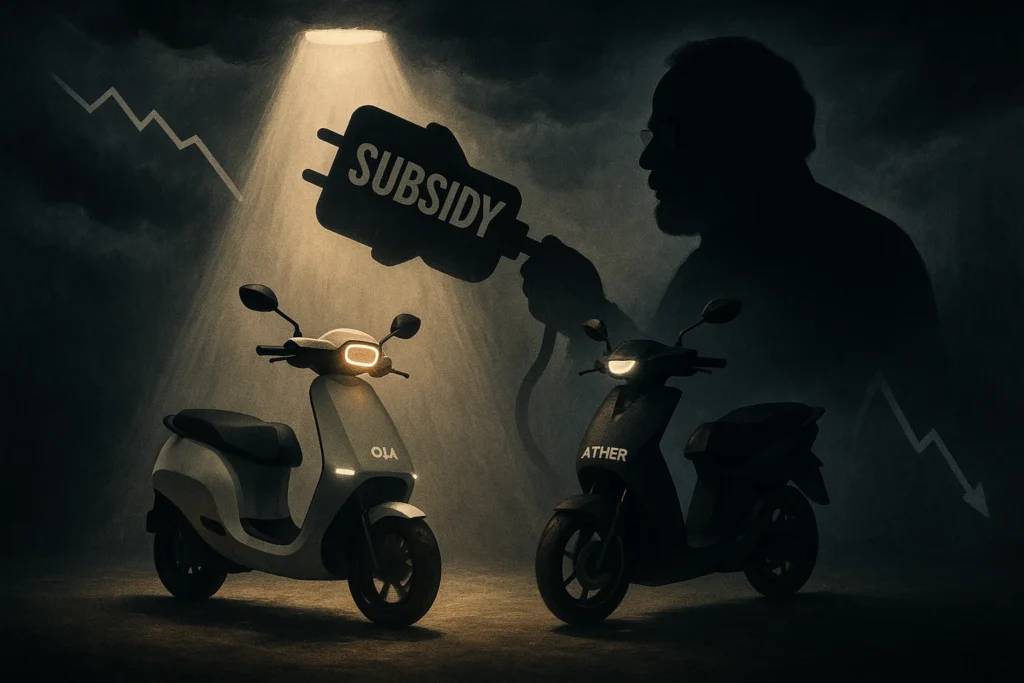
Introduction – A Revolution on Two Wheels
EV stocks in India are drawing investor attention as Ola Electric and Ather Energy lead the charge in the country’s two-wheeler revolution.
India’s streets are noisy, chaotic, and full of life. For decades, two-wheelers have been the backbone of mobility, from buzzing scooters in metro traffic to motorbikes zipping across rural highways. In FY25, over 20 million two-wheelers were sold, making India one of the largest two-wheeler markets globally.
But something has shifted. For the first time, electric vehicles (EVs) are moving from futuristic gimmick to mainstream reality. The electric two-wheeler (E2W) segment has grown from 6.1% penetration in FY25 to 7.6% by July 2025, and projections say it will hit 35–40% by FY31 — a massive 41% CAGR.
At the heart of this EV boom are two names: Ola Electric Mobility and Ather Energy. Both are pioneers, both are disruptors, and both are magnets for investors hunting the best EV stocks in India.
But here’s the million-dollar question (or, more accurately, the billion-dollar one):
👉 Can Ola and Ather build a sustainable, profitable future once subsidies run out?
Subsidy Dependency: The Fuel Behind the Fire
The EV transition isn’t happening in isolation. It’s happening because the Indian government has poured massive support into the sector.
- PLI scheme Ola Electric: Ola is one of the biggest beneficiaries of the Production-Linked Incentive (PLI) framework. Its Gen 3 scooters qualify for 13–18% incentives until 2028, which directly improve margins and pricing competitiveness.
- FAME scheme EV India: Ather Energy grew rapidly under the FAME-II subsidies, making its premium scooters more affordable for early adopters. But when subsidies were slashed in 2023–24, demand dipped — a clear reminder of how dependent the industry is on government help.
This isn’t unique to India. Globally, EV adoption in markets like China, the US, and Europe was also heavily subsidy-driven. But here’s the catch: subsidies don’t last forever. And once they fade, EV stock profitability becomes the ultimate test.
The Hard Truth of Financial Performance
For investors, numbers tell the story better than promises. Let’s look at the Ola Electric financial performance and Ather Energy financials side by side:


Revenue Growth (₹ millions)
- Ola: 3,734 (FY22) → 26,309 (FY23) → 50,098 (FY24) → 45,140 (FY25)
- Ather: 4,089 (FY22) → 17,809 (FY23) → 17,538 (FY24) → 22,550 (FY25)
Net Losses (₹ millions)
- Ola: -7,841 → -14,721 → -15,844 → -22,760
- Ather: -3,441 → -8,645 → -10,597 → -8,123
Margins (FY25)
- Ola: -46.15% Net Margin, -38% OPM
- Ather: -36.02% Net Margin, -33.34% OPM
Both companies are still deep in the red. Ola’s revenues look more impressive but come with larger losses. Ather’s smaller base means slower top-line growth, but it is gradually improving efficiency.
For investors, this is where optimism meets caution. EV stocks in India may look like the future, but their present balance sheets paint a picture of risk.
Why EV Profitability is So Elusive
The losses aren’t just poor execution — they are structural. Let’s break down why EV stock profitability is such a puzzle:
- High upfront costs: Building gigafactories, investing in R&D, and setting up new models cost billions. Ola’s 4680 Bharat Cell project is visionary but capital-intensive.
- Price wars with giants: Legacy OEMs like Hero, Bajaj, and TVS can cross-subsidize EVs with their profitable petrol bike businesses. Startups like Ola and Ather don’t have that cushion.
- Consumer trust gap: Ola faced a wave of customer complaints on service and reliability. Ather, while premium-focused, faces the challenge of scaling quality across India.
- Infrastructure bottlenecks: Charging, service centers, and after-sales networks are expensive to scale, especially in Tier 2 and Tier 3 cities where demand is rising.
Put simply: selling scooters is easy, but making EV stock profitability sustainable is much harder.
Ola Electric: Betting Big on Scale and Vertical Integration
Ola Electric is swinging for the fences. Its strategy is clear — control the entire value chain and bet on scale.
- Gigafactory advantage: Already at 1.4 GWh capacity, with plans to hit 5 GWh by FY26, Ola aims to cut battery costs drastically. If successful, this will be a major moat.
- PLI scheme Ola Electric: Incentives add a crucial cost buffer until 2028.
- Aggressive expansion: Ola isn’t just stopping at scooters. It has announced electric motorcycles (like the Roadster) and three-wheelers, aiming to dominate across categories.
- Ambitious targets: Management has projected 3.25–3.75 lakh unit sales in FY26.
But big bets mean big risks. If execution falters, the cash burn could overwhelm. For now, Ola represents the high-risk, high-reward EV stock in India.
Ather Energy: Playing Smart with Premium Positioning
Ather Energy is taking a different path. Instead of chasing mass-market dominance, it focuses on quality, tech, and customer stickiness.
- Premium but scaling: Its latest scooter, Rizta, already contributes 60% of monthly sales, proving demand in family and utility segments.
- Capacity expansion: The upcoming Chhatrapati Sambhajimagar plant will support 500,000 units annually by 2027, expandable to 1M.
- Recurring revenue model: With 88% attach rate for its AtherStack Pro Pack, the company has created a software-driven subscription revenue stream.
- Innovation: Exploring Battery-as-a-Service could reduce upfront costs, making Ather more accessible while locking customers into long-term engagement.
This makes Ather the “premium + capital efficient” play. It may not explode in scale like Ola, but it could achieve EV stock profitability earlier by keeping costs under control.
Global Lessons: Why Subsidy-Free Profitability Matters
Looking globally, EV startups often struggle post-subsidy:
- In China, dozens of EV startups collapsed when incentives tapered. Only giants like BYD and Nio survived.
- In the US, Tesla made it through because of vertical integration and early premium positioning — similar to Ola + Ather’s hybrid strategies.
For investors watching EV stocks in India, the key question is: will Ola be the “Tesla of India” or another subsidy-dependent casualty? Will Ather’s capital efficiency be enough to survive in a market where scale often wins?
Investor Takeaways: Who Fits Which Portfolio?
Both Ola and Ather are unprofitable today, but their futures could diverge.
- Ola Electric:
- Suits aggressive investors chasing disruption and scale.
- High cash burn + execution risk.
- Ather Energy:
- Suits investors preferring disciplined growth, recurring revenues, and brand trust.
- May scale slower, ceding mass-market share to competitors.
For now, both are speculative plays. But as EV penetration in India surges toward 35–40% by FY31, one of these could emerge as a leader in the EV stocks in India story.
Conclusion – The Real Race
The battle for EV supremacy in India isn’t about who sells more scooters today. It’s about who can survive without subsidies and reach profitability before the clock runs out.
Ola has the scale, Ather has the discipline. Investors betting on EV stocks in India must choose: do you believe in the big gamble, or the smart, steady grind?
Because when subsidies fade, only one question will matter:
👉 Who’s still standing profitably in the electric future of Indian mobility?
FAQs
Q1. What are EV stocks?
They are shares of companies engaged in the electric mobility space, such as Ola Electric and Ather Energy.
Q2. Why is the Indian EV market in focus now?
Because the two-wheeler segment is expected to reach 35–40% electric penetration by FY31, growing at 41% CAGR.
Q3. How do subsidies impact Ola and Ather?
Schemes like FAME and PLI make EVs more affordable. Reducing or removing them could affect demand and margins.
Q4. Which company has higher revenue — Ola or Ather?
Ola reported ₹45,140m in FY25 revenue, compared to Ather’s ₹22,550m.
Q5. Which company has lower losses?
Ather’s FY25 net loss was -₹8,123m, while Ola posted -₹22,760m.
Q6. What is Ola’s growth strategy?
It focuses on vertical integration, its Gigafactory, and expanding into motorcycles and three-wheelers.
Q7. What is Ather’s growth strategy?
Ather emphasizes premium positioning, a software-driven ecosystem, and expanding production capacity to 500,000 units by 2027.
Q8. What are the main risks for these companies?
Execution challenges, subsidy dependency, competition from legacy players, and ongoing financial losses.
Q9. Which company looks safer for investors?
Ola offers bigger scale but higher risk, while Ather shows more controlled, capital-efficient growth.
Q10. Should I consider investing now?
It depends on your risk tolerance — EV adoption is a long-term trend, but profitability is still uncertain.
Related Articles:
How to Read Quarterly Results: A Beginner’s Guide to Earning Reports
Golden Crossover vs Death Crossover: How to Use These Powerful Chart Signals
Protect Your Demat Account from Cyber Threats: A Complete Guide
More Articles
How to Transfer Shares from Groww to Zerodha – Full Guide (2025)
Best Screener Queries for Stock Selection: Find Hidden Gems Before Others Do
How a Tea Seller Used the Power of Compound Interest to Build ₹45 Lakh